
The snake that mimics a spider to lure birds
When Anthony Herrel first watched the footage in 2014, he could hardly believe what he was seeing. A research director at France's national scientific research agency (CNRS) at the Muséum national d'histoire naturelle in Paris, Herrel had been alerted by an Iranian colleague to a video showing behavior never before documented in snakes.
"The snake had been known for more than ten years, but its behavior had never been observed," Herrel recalled. "I was stunned. I had never seen anything like it. Honestly, it looks just like a spider."
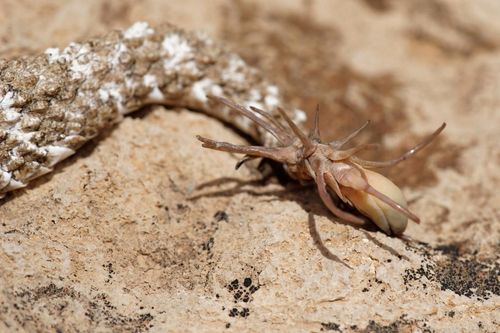
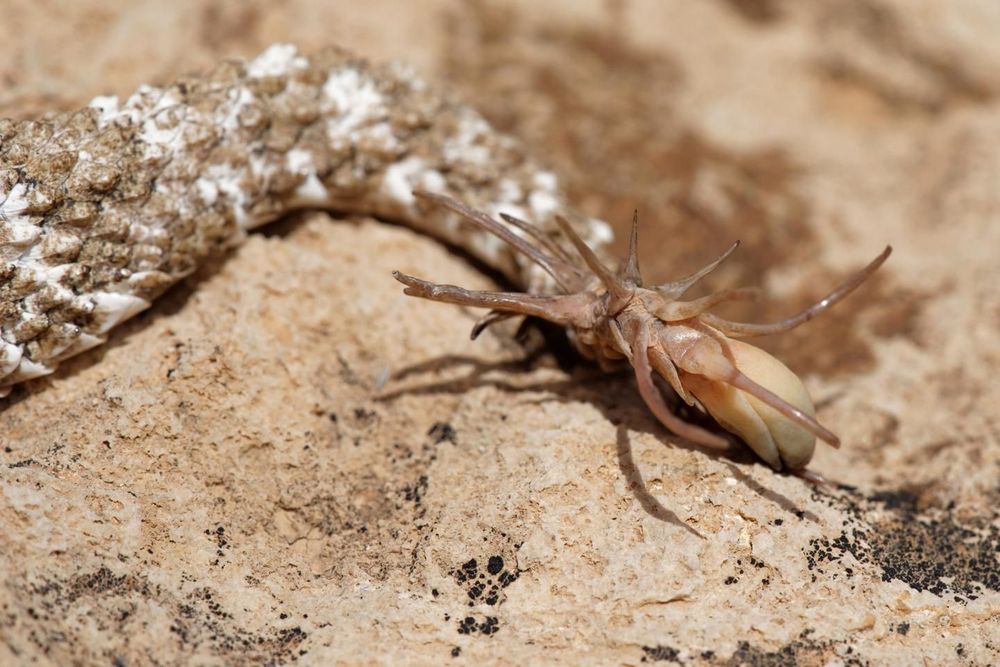
The animal in question was Pseudocerastes urarachnoides, commonly known as the spider-tailed horned viper. In the video, what appears to be a spider moving across rocks suddenly transforms into a deadly ambush as a bird approaches. The viper's tail, remarkably resembling an arachnid, serves as bait in one of nature's most elaborate deceptions.
Since that initial footage and the publication in 2015 of a detailed description of the snake's behavior, herpetologists worldwide have been captivated by this remarkable predator. The species, which inhabits the rugged terrain of western Iran's Zagros Mountains and a small portion of eastern Iraq, represents an extraordinary example of aggressive mimicry in the animal kingdom.
A long-hidden specimen
The story of the spider-tailed viper's scientific discovery stretches back further than many realize. The first specimen was collected in 1968 during the Second Street Expedition to Iran and deposited at the Field Museum of Natural History in Chicago. However, scientists at the time misidentified it as Pseudocerastes persicus, dismissing its unusual tail as a parasite, deformity, or tumor rather than recognizing it as a unique adaptation.
It wasn't until 2006 that Bostanchi, Anderson, Kami and Papenfuss formally described the spider-tailed horned viper as a new species in the Proceedings of the California Academy of Sciences, based on the 1968 specimen and additional material collected in 2003.
Solving the anatomical puzzle
Georgios Georgalis, a paleontologist at the Polish Academy of Sciences in Krakow who studies reptile skeletal anatomy, had long been curious about this unusual snake. "It surely has one of the strangest tails among reptiles," he noted.
At a conference in 2023, Georgalis met Sara Ruane, deputy director of the herpetology department at the Field Museum in Chicago. Their collaboration would prove fortuitous in unlocking the viper's secrets.
Recent CT scanning studies published in The Anatomical Record in September 2026 revealed a surprising finding: the spider-like tail appendage is made entirely of modified skin and scales, not specialized bones. The underlying vertebrae appear remarkably normal for a viper, suggesting that the elaborate mimicry evolved through changes to soft tissue rather than skeletal structure.
A specialized hunting strategy
The viper's hunting technique exemplifies what scientists call caudal luring, a form of aggressive mimicry documented across multiple snake families. In this strategy, cryptically colored snakes wave conspicuous tail tips to mimic invertebrates, attracting prey that feeds on such organisms.
The spider-tailed viper takes this strategy to an extreme, with its tail appearing to specifically mimic the camel spider (Galeodes arabs), which shares its mountain habitat. When a bird investigates what appears to be easy prey, the viper strikes with specialized venom that acts as both a cytotoxin and procoagulant, coagulating blood in approximately 13 seconds.
The viper's specialized adaptation has captured public imagination beyond scientific circles. The snake's behavior was featured in the BBC's 'Seven Worlds, One Planet' series narrated by David Attenborough, bringing wider attention to this remarkable species.
Conservation concerns
Despite its remarkable adaptations, the spider-tailed horned viper faces an uncertain future. The species is classified as Near Threatened by the IUCN, reflecting concerns about its extremely limited geographic range and specialized habitat requirements.
Climate modeling studies suggest that future climate change may dramatically alter the viper's prospects. Projections indicate that by 2100, suitable habitat for Pseudocerastes urarachnoides could be displaced under multiple emission scenarios, creating a mismatch between current and future habitat ranges.
For a species so highly adapted to its specific environment, with its unique hunting strategy finely tuned to local prey and conditions, such habitat displacement could pose significant survival challenges. The spider-tailed viper's story serves as a reminder that even nature's most ingenious adaptations may not be enough to overcome rapid environmental change.