
First arrivals mark start of controversial program
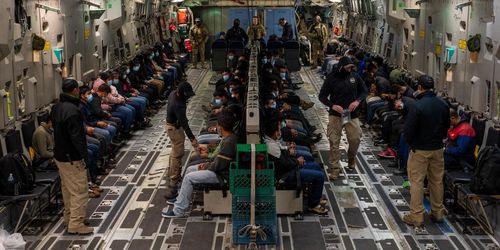
Twenty migrants deported from the United States landed in Liberia on Thursday, August 20, marking the beginning of an agreement under which the West African nation will accept up to 1,200 foreign nationals over the next year. The arrivals are part of President Donald Trump's expanded immigration enforcement program, which targets individuals who previously held legal protections allowing them to live and work in the US.
The plane touched down at Liberia's international airport near Monrovia shortly before 1:00 pm local time. Staff from the Liberian Commission on Repatriation, Resettlement and Reintegration took charge of the new arrivals, who boarded a bus and left the airport. Journalists were kept at a distance and could not speak with the deportees.
Liberian Information Minister Jerolinmek Piah indicated earlier this week that the 1,200 deportees will include nationals from Africa, North America, South America, and the Caribbean. The government stated that these individuals are "free to depart the country when they so desire" or apply for asylum, describing the program as "entirely humanitarian."
Part of broader deportation network
Liberia joins a growing list of African countries participating in the Trump administration's third-country deportation program. As of March 2026, the administration has signed agreements with 27 countries, resulting in approximately 23,000 people being deported to 26 nations under these arrangements. Other African signatories include Sierra Leone, Equatorial Guinea, Ghana, Rwanda, South Sudan, Cameroon, Eswatini, and the Democratic Republic of the Congo.
The Liberian government said it "has not demanded or received any compensation or promise of rewards in exchange for its consent to participate in the program," though it noted that "Liberia will receive support to help manage this program and strengthen its migration system more generally." Discussions between Liberia and the Trump administration appear to have begun in July 2025 during a White House Africa Summit attended by only five of the continent's more than 50 heads of state.
Legal challenges and policy expansion
Trump's second term has significantly broadened deportation eligibility by ending Temporary Protected Status for 13 countries, affecting roughly 1 million out of 1.3 million TPS recipients and making them newly vulnerable to removal. The administration has argued it is legally permitted to send such individuals to third countries, even when barred from deporting them directly to their nations of origin due to persecution fears.
On February 25, 2026, a federal court ruled that the administration's third-country removal system violates the US Constitution and immigration law, though deportations have continued despite the ruling. Between January 2025 and March 2026, Human Rights Watch reported that the administration deported almost 13,000 third-country nationals to Mexico, raising concerns about due process and access to basic services.
A February 2026 US Senate Foreign Relations Committee minority report highlighted significant costs associated with the program, estimating that the administration paid more than $181,000 per person to deport a Jamaican national to Eswatini, who was subsequently flown back to Jamaica weeks later at US expense.
Regional responses vary
Not all African countries have agreed to participate. Nigeria's Foreign Minister Yusuf Tuggar publicly stated that the US was pressuring African nations to accept Venezuelan deportees, including some released from prison, but Nigeria refused, citing its own population challenges with 230 million people.
Ghana has taken a different approach. President John Mahama confirmed that 14 deportees arrived in his country, including several Nigerians and a Gambian, whom Ghana then facilitated to return to their home countries, using regional protocols to transit rather than permanently host the individuals.