
US Supreme Court delivers Trump a temporary win on mail-in voting
The US Supreme Court delivered President Donald Trump a partial legal victory on Monday, August 24, lifting a lower court injunction that had blocked his executive order restricting mail-in ballot usage. However, implementation of the directive remains halted under a separate nationwide injunction.
The Republican president signed Executive Order 14399, formally titled "Ensuring Citizenship Verification and Integrity in Federal Elections," on March 31, 2026. The order directs the Department of Homeland Security to work with the Social Security Administration to create state-by-state lists of eligible voters using federal databases, though these databases have well-documented accuracy issues. The order would also require the US Postal Service to deliver ballots only to voters appearing on these lists.
Democratic-led states immediately challenged the directive in court, arguing that under Article I, Section 4 of the US Constitution—known as the Elections Clause—states retain primary authority over the "times, places, and manner" of holding federal elections, while Congress holds secondary power to "make or alter" such regulations. The Constitution does not grant the President direct authority over election administration.
US District Judge Indira Talwani in Massachusetts issued an injunction in June 2026 blocking key provisions of the executive order, finding them unconstitutional. The 1st US Circuit Court of Appeals upheld her ruling in late July. The Supreme Court's decision on Monday lifted that specific stay, allowing parts of Trump's directive to potentially proceed.
The Court's 6-3 decision split along ideological lines, with the three liberal justices—Sonia Sotomayor, Elena Kagan, and Ketanji Brown Jackson—dissenting.
"The District Court lacked jurisdiction to bar the Government from trying to implement" the executive order, the Supreme Court majority said in an unsigned opinion.
However, the justices withheld final judgment on the merits of the case.
"The Court's disposition of this application does not mean that any measure taken by the Government to implement the Order will necessarily be lawful," they cautioned. "On that score, time will tell."
Despite Monday's ruling, a separate nationwide injunction issued by Judge Talwani on August 11, 2026, in a lawsuit brought by nonprofit groups led by the League of Women Voters, remains in effect. This means implementation of the executive order is still blocked across all states.
Senate Minority Leader Chuck Schumer, a Democrat, called the decision a "disgrace," adding that Trump "wants to make it harder for Americans to vote so they don't hold him accountable for the skyrocketing costs, illegal war and rampant corruption that are a hallmark of his administration."
California Governor Gavin Newsom, widely viewed as a potential Democratic presidential candidate, announced his state would file another lawsuit over the matter.
High stakes for midterm elections
The dispute arrives as Republicans face potential losses in November's midterm elections. The party currently holds a narrow 220-215 majority in the House of Representatives, meaning Democrats need to gain a net of three seats to seize control of the chamber. If Democrats win, they have signaled they will block Trump's agenda and could move to impeach him for the third time.
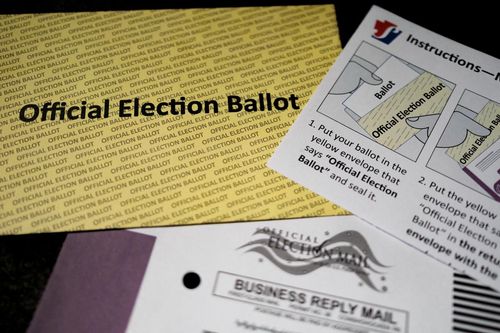
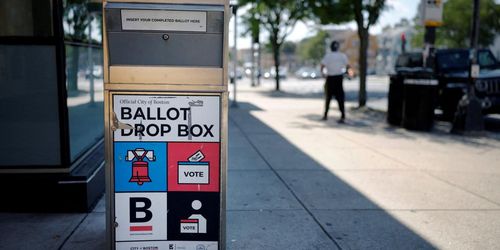
Mail-in voting has become a significant component of American elections. In the 2024 general election, approximately 31% of Americans—more than 48 million voters—cast their ballots by mail. That figure represented a decrease from 2020, when 42-43% of votes were cast by mail, a surge driven by the COVID-19 pandemic.
Eight US states—California, Colorado, Hawaii, Nevada, Oregon, Utah, Vermont, and Washington—plus Washington, DC, automatically mail ballots to all registered voters, conducting elections primarily by mail. Another 28 states allow no-excuse absentee voting by mail.
Trump has been a longtime critic of mail-in ballots but has frequently used them himself, including this month when he voted by mail in Florida's Republican primary. He has for years claimed without evidence that mail-in voting is highly vulnerable to fraud, repeatedly linking it to his false assertion that the 2020 presidential election was stolen from him by Democrat Joe Biden.
"Mail-in ballots are inherently corrupt," he said during a July speech on election security.
The executive order was issued amid Senate debate over the SAVE America Act, legislation backed by Trump and Senate Republicans that would require proof of citizenship to register and government-issued photo identification to vote in federal elections, part of a broader Republican effort on election integrity and voter verification.