
Rome's Spin Time social center faces uncertain future as Meloni government intensifies crackdown on occupied buildings
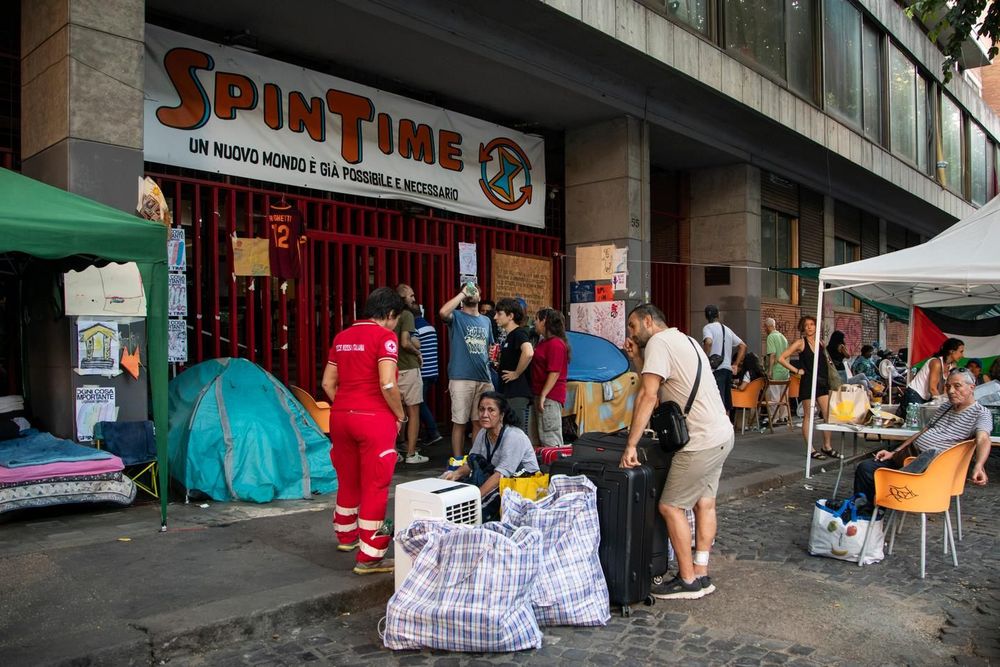
For three weeks in August, dozens of Decathlon tents lined Via di Santa Croce in Gerusalemme in Rome's central Esquilino neighborhood, sheltering nearly 400 people forced from their home after a fire broke out on the night of July 29. The building they evacuated was no ordinary residence: it housed Spin Time, a self-managed social center that has become a symbol of left-wing activism in Italy's capital.
By late August, only a few dozen people remained on the street, sitting on mattresses or plastic chairs while children played football. Residents entered the building one by one, accompanied by police officers, to collect personal belongings. The future of the center now hangs in the balance as Prime Minister Giorgia Meloni's government makes closing such sites a central political objective.
A Decade of Alternative Living
The former INPDAP office block of approximately 17,000 square meters was occupied on October 12, 2013 by around 300 people supported by the housing rights movement 'Action'. Over the years, Spin Time evolved into a distinctive social experiment, bringing together residents from 27 countries. The building included performance halls, a restaurant, a print shop, classrooms and a job placement office.
This model belongs to a broader tradition in Italy. Self-managed social centers first emerged in the mid-1970s, suffered repression during the Years of Lead, then experienced a resurgence in the late 1980s and early 1990s. By 2006, an estimated 150 such centers operated across Italy, clustered mainly in Milan, Rome, and Turin. According to a 2019 interior ministry map, Italy had approximately 165 community centers linked to anarchist and far-left political areas, of which 78 were occupied buildings.
It's a world that brings together the poor, the young and migrants, and wants to represent humanity in the face of a culture of profit
said Paolo Perrini, the 67-year-old president of Spin Time. The veteran activist, who participated in anti-G8 protests in Genoa in 2001, added:
Politics cannot be a slave to the market and must serve the common good.
High-Profile Support and Controversy
Spin Time's political significance was highlighted in 2019 when Cardinal Konrad Krajewski, the Pope's almoner, broke a police seal and descended into a manhole to personally restore electricity after the supply was cut over unpaid bills. The dramatic intervention caused a diplomatic spat with then-Interior Minister Matteo Salvini, underscoring the center's controversial status and the involvement of both Church and state officials in its fate.
A Nationwide Crackdown
The evacuation of Spin Time represents just one front in the Meloni government's broader campaign. In August 2025, authorities evicted the historic Leoncavallo social center in Milan, which had operated since 1975. Prime Minister Meloni defended the action, stating:
In a constitutional state, there cannot be free zones or areas exempt from legality
adding that
illegal occupations are a threat to security.
Since the start of the Meloni government's mandate, nearly 4,000 squatted buildings have been repossessed across Italy, according to Interior Minister Matteo Piantedosi. A new security law that came into force in June 2025 increased jail sentences for squatters from a maximum of three years to seven years and enables police to evict squatters without court permission, representing a significant shift in enforcement powers.
Housing Crisis Context
The proliferation of occupied buildings must be understood against the backdrop of Italy's severe housing shortage. Italy's public housing stock managed by 85 housing corporations numbers approximately 797,000 social housing units, minimal compared to major European countries where the public sector's housing provision is as much as ten times larger. Over 300,000 families remain on waiting lists.
In Rome specifically, the housing crisis has been particularly acute. In 2018, the city's association of construction entrepreneurs estimated that 37,500 housing units were vacant or unsold since the 2008 crisis, while 57,000 families experienced conditions of housing inadequacy or segregation.
For Perrini and Spin Time's residents, this context justifies their occupation. However, as the Meloni government continues its crackdown with enhanced legal tools and political will, the era of such self-managed spaces appears increasingly precarious. The tents on Via di Santa Croce in Gerusalemme may soon disappear, but the housing crisis that gave rise to Spin Time remains unresolved.