
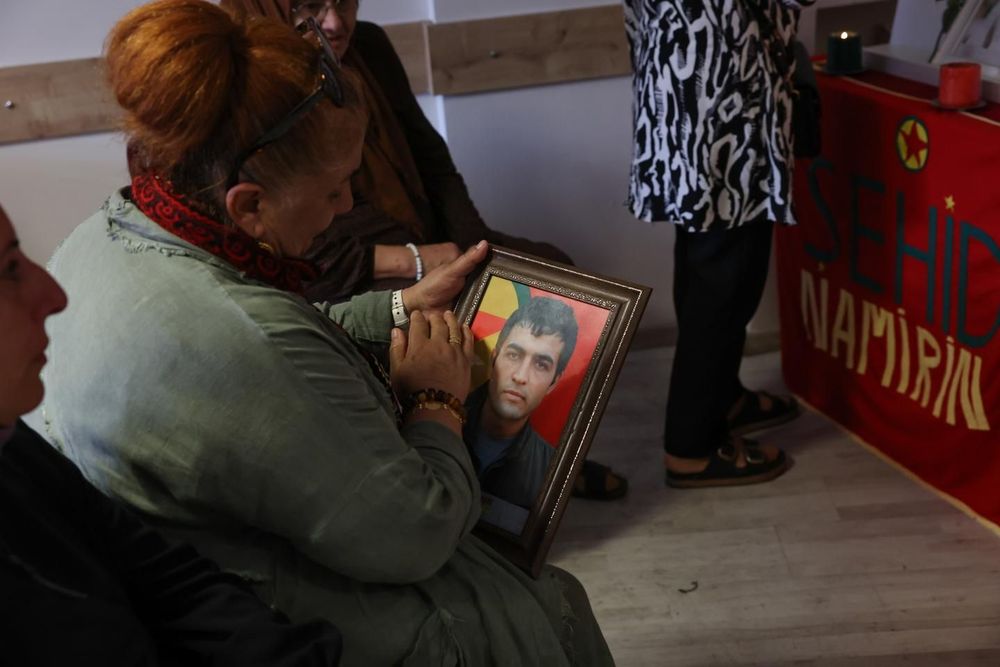
In Turkey, public funeral ceremonies honor fallen PKK fighters
When Mehmet Sasik answered his phone on Friday, August 21, he initially thought the call brought good news. The caller identified themselves as representing the Peoples' Equality and Democracy Party (DEM), Turkey's third-largest parliamentary party, which has been serving as an intermediary in the ongoing peace process between the Turkish government and the Kurdistan Workers' Party (PKK).
"We are in the midst of a peace process, so I reassured my mother by saying it must be a good sign," recalled the man in his forties, his voice barely audible as he sat in silence. The reality proved far more complex.
His younger brother, Hakan, had vanished without warning in 2014. "For more than 24 hours, we couldn't reach him. At first, we thought it was an accident, since Istanbul is such a big city," Mehmet explained. "Then at the police station, we were told he had joined the PKK." The organization, designated as a terrorist group by Turkey, the United States, NATO, and the European Union since the 1990s, has waged an armed campaign since 1984 that has resulted in more than 40,000 deaths among civilians, security forces, and fighters.
Childhood shaped by conflict
Mehmet's memories of their childhood in Kars, a northeastern city that was a focal point of intense military operations in the 1990s, help explain his brother's path. During that decade, Turkish forces conducted widespread operations in Kurdish-majority regions, including the creation of military "forbidden zones" in mountainous areas around Kars. "I remember the violent raids by the army at our home in the 1990s," Mehmet said, his gaze empty.
The family eventually relocated to Istanbul, settling in the outlying district of Arnavutköy on the European side of the metropolis. Despite the geographic distance from the conflict zone, the impact of those early experiences remained. "Hakan was outraged by the injustices he witnessed," Mehmet continued. "His decision to join was not entirely a surprise. I respect his choice."
After Hakan's disappearance, the family heard almost nothing for 12 years, save for rumors of an ear injury. Then came the August phone call that changed everything.
A new peace process emerges
The call to the Sasik family came amid a dramatic shift in Turkey's approach to the decades-long conflict. In February 2025, imprisoned PKK founder Abdullah Öcalan issued a historic appeal calling for the organization to convene a congress, disarm, and dissolve. By May 2025, the PKK formally announced its decision to renounce armed struggle and disband, though Turkish authorities have emphasized that disarmament must be verified before broader legal provisions can proceed.
In August 2026, Turkey's parliament approved landmark legislation granting conditional amnesty to PKK members, with provisions taking effect as the organization moves toward full dissolution. The legislation, published in Turkey's Official Gazette, represents a significant step in a peace process that many view as the successor to a failed 2013-2015 initiative that collapsed after Turkey's general elections and led to renewed violence.
The current developments have enabled something previously unthinkable: public funeral ceremonies for fallen PKK fighters in Turkish cities. The DEM Party has taken on the role of notifying families and organizing these events, which now occur openly at party offices rather than in secrecy or exile.
Uncertain hope
For Mehmet Sasik, the peace process brings both closure and continued uncertainty. His brother Hakan, who joined the PKK in 2014, is among those whose sacrifice is now being publicly acknowledged. The family has been able to hold a funeral ceremony, an opportunity that would have been impossible just months earlier.
Yet the weight of loss remains heavy. "I respect his choice," Mehmet said of his brother's decision to join the armed struggle, but his voice carried the strain of 12 years without contact and the finality of the news he received. The peace process has given families like the Sasiks a chance to mourn openly, but it cannot restore the years lost or the lives ended in a conflict that has spanned four decades and shaped multiple generations.