
Carrefour reopens in India with franchise model after 12-year hiatus
On a recent afternoon in Greater Noida, a suburb of New Delhi, Saurabh Singh browsed the drinks section of the newly opened Carrefour hypermarket with visible enthusiasm. The cybersecurity firm employee, making his second visit to the store, praised the extensive selection and organization. "There are so many choices. Everything is attractive, well organized, well lit. The aisles are clean, and there are plenty of quality products," he said while loading bottled water into his cart.
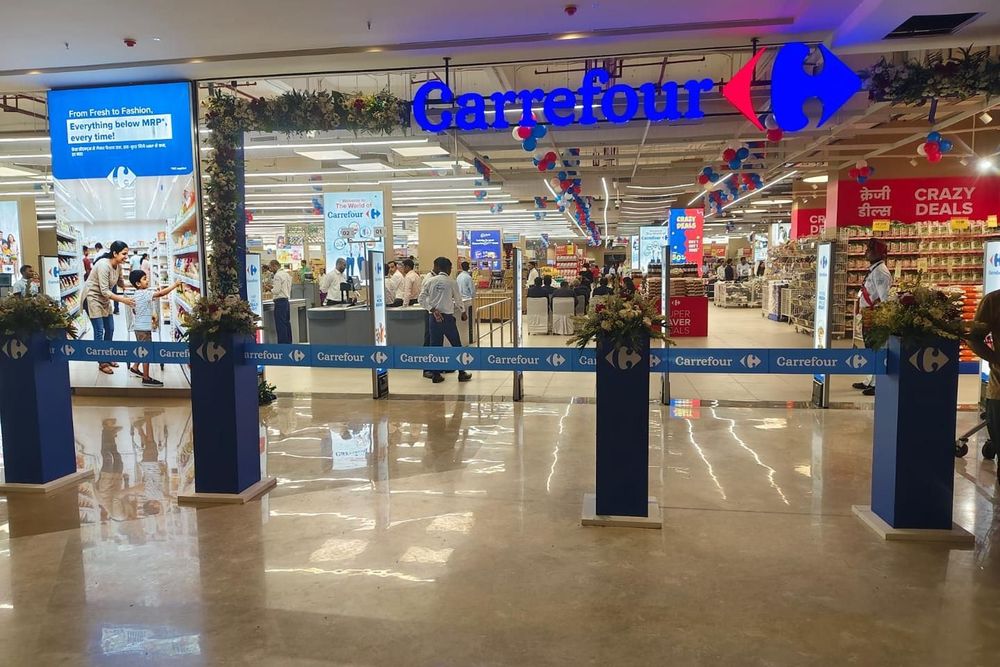
The French retail giant has returned to India after a 12-year absence, marking a strategic pivot in how it approaches one of the world's fastest-growing consumer markets. On August 14, Carrefour opened a 4,500-square-meter hypermarket in the basement of a shopping mall in Greater Noida, signaling its renewed ambitions in the country.
"Our main target is the middle class living not far from the store," explained Patrick Lasfargues, executive director of Carrefour International Partnership.
The store's competitive positioning is immediately apparent. Shoppers encounter large bins of rice and spices at the entrance, staples of Indian cuisine available for self-service purchase in bulk. The product range extends to 15,000 items, approximately 80 percent of which are manufactured in India. Apparel starts at 99 rupees (€0.90), while the shelves stock everything from fresh produce and cooking oil to personal care items, kitchen utensils, gardening equipment, and children's backpacks.
A different approach after previous setback
Carrefour's return comes through a franchise partnership with Dubai-based Apparel Group, a strategic shift from its previous direct operation model. The retailer first entered India in 2010, opening cash-and-carry wholesale stores, but withdrew in September 2014 after operating just five locations. The company cited difficulties finding suitable partners for expansion and challenging market conditions.
That exit was not an isolated retreat but part of a broader global restructuring. Between 2012 and 2014, Carrefour pulled out of Indonesia, Malaysia, Colombia, Singapore, and Greece, divesting operations worth over $3.5 billion to concentrate on core markets.
The franchise model now employed sidesteps India's complex foreign direct investment regulations. While the country permits up to 51 percent foreign equity in multi-brand retail, the rules require minimum investments of $100 million, mandate that half the investment go toward back-end infrastructure, and require state-by-state approval. Only 12 states and union territories have agreed to allow such foreign retail operations.
Through its partnership with Apparel Group, Carrefour plans to open approximately 50 stores across North India over the next three to four years, focusing on the National Capital Region and Uttar Pradesh.
Targeting a massive market opportunity
The timing reflects both Carrefour's broader international strategy and India's retail market dynamics. India's retail sector was valued at approximately $1,060 billion in 2025 and is projected to nearly triple to $3,121 billion by 2035. Organized retail alone is expected to reach $230 billion by 2030.
Carrefour's India reentry fits within an ambitious global franchise expansion. The company aims to grow its international presence from 33 countries to 60 by 2030, with India serving as a cornerstone of its 2026 development plan to enter more than 10 new markets.
The retailer is entering a rapidly evolving landscape. India's e-commerce and online retail market reached approximately $229.77 billion in 2026, driven by rising internet penetration, digital payment systems like UPI, and government initiatives promoting digital commerce. This digital transformation has reshaped consumer expectations and competitive dynamics.
Demographic trends also favor organized retail expansion. Tier-II and Tier-III cities are adding nearly 100 million new consumers to branded and organized retail by 2030, fueled by rising disposable incomes and increased digital exposure. This growth beyond metropolitan areas is driving demand for mid-format retail stores in suburban locations like Greater Noida.
Whether Carrefour's franchise-based return will succeed where its direct operations previously failed remains to be seen. But the retailer is betting that a different business model, combined with India's transformed retail landscape, will yield different results this time around.